Historically prisons were very small in Britain, built of stone, often tall narrowish buildings, with small windows, and of course a very big, heavy, key.
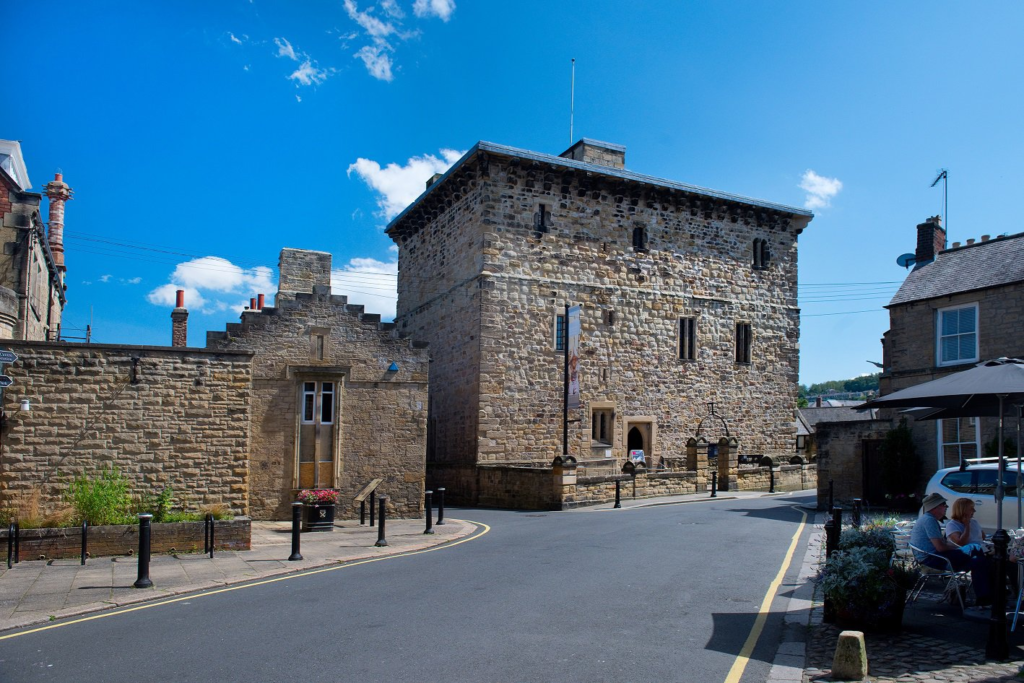
https://www.northeastmuseums.org.uk/hexhamoldgaol/about
Hexham Old Gaol is the earliest recorded purpose-built prison in England. It was ordered in July 1330 by William Melton, Archbishop of York, who sent a letter to Thomas Fox, Receiver of Hexham, demanding a gaol where his prisoners could be securely guarded.
The archbishop ruled over Hexhamshire, and the construction of the Gaol was a symbol of his great wealth and power. Any fines from offences committed in the area were paid to the archbishop, so it made sense to open his own gaol as a way of making money and controlling the people who lived and worked on his land.
Prisons up until this point had normally been part of castle buildings or were in buildings that had been adapted from their original use.
The Gaol was completed in January 1333, made from the stone of Corbridge Roman Fort, located just three miles away.
It was fitted with torture and punishment devices such as manacles and fetters. Prisoners, depending on their status and the seriousness of their crimes, were held on three floors. The dungeon was a miserable place for the poorest and most hardened of criminals. It was dirty, smelly and overcrowded. In contrast, the first floor was a much more pleasant experience for wealthy prisoners.
The Gaolers lodgings were on the top floor. The first Gaoler of the prison was John de Cawood, who was employed in 1332. He was paid 2d and his job was to oversee the prisoners. When they arrived, he would search them, put them in chains and escort them to their living quarters.
Gaolers were expected to earn more money by charging the prisoners additional fees:
- Admission fee – 4d
- Restraints such as chains or iron – 1d
- Bedding, made up of a straw mattress, pillow and cover – 1d
- Shoes – 1/2d
- Fuel for fire – 1d
It’s likely that wealthier prisoners bribed the Gaoler for extra privileges, such as, better food, better bedding, access to the Market Place to beg for alms, and to be able to attend church.
The Gaoler managed the prisoners’ work. Prisoners were expected to contribute to the running of the Gaol, carrying out tasks such as cleaning toilets and collecting urine for selling to the local tanning industry.
The Gaolers were expected to maintain law and order but that was a very difficult job when prisoners were allowed to gamble, often getting into arguments and attacking each other, and women and children were not segregated from men.
Prisoners were not regularly cleaning themselves or their clothes, so lice was a major problem. Typhus, also commonly known as ‘gaol-fever’, was a bacterial infection spread by fleas and lice, and was rife throughout the Gaol. It caused rashes, fevers and chills. If left untreated it was fatal. Prisoners would fall into a coma and die.
The Gaol was infected several times by the plague, a disease spread by the permanent presence of rats.
https://www.northeastmuseums.org.uk/hexhamoldgaol/about
The above link is copied again, because the brief history of Hexham Old Gaol is copied straight from the website.
This blog has visited and spent a very informative morning, and remarkable it is in how much societal function is contained within the stone building. The stones from nearby Corbridge Roman Fort, active with Romans suppressing us natives around 1,000 years ago. Stone lasts a very long time, and the Earth on which we all spin is 4.5 billion years old. The Earth has orbited Sol all that time, and is likely to last a while longer.
The prisons in castles were even tougher, harsher, and had smaller or no windows and the prisoners were more likely than not never to reappear. When Kings and Queens ruled Britain it was just the King and their Army, and the castle represented the immediate situation. Berwick upon Tweed Castle in the 1200s, 1300s, 1400s was taken by English, Scottish, English, Scottish, the attacks went one way then the other, with much loss of life every time. Carlisle Castle from 1092 as the northernmost stronghold of the Norman powers coming up north over the lands of Britain were besieged 7 times to 1461, and the Scots showed no mercies. No delivery of pizzas, no showers, no water at all at times, all in a fairly wet and chilly climate during the long winter months.
Hexham Old Gaol, and the word Gaol looks far more like a prison than the modern jail, as the property of the Archbishop of York does of course carry our strange history in Britain of the parallel power of the Church, and 1330 was before it got even more complicated with the Protestant movement over Northern Europe and Henry VIII’s Church of England. But never mind, for the purposes of this blog the Archbishop of York in 1330, William Melton, represented the totality, like a miniature State all of his own. His power did come from the Church institution behind him, but up in York and his empire over Hexhamshire, he was in charge, and the parameters were clear. His prison fitted those parameters in location and numbers of people being held there. No doubt there would be busier times and emptier times, and because he was in charge, there would be ways of dealing with just too many prisoners to fit in, and no legal system to appeal to.
This blog being very interested in societal arrangements of the humans does see the tribes and natives groups as the healthiest and happiest because, like a JD Wetherspoon pub, no one wants to be chucked out. In tribes and native groupings, even if in urban modern cities, everyone has a role, a function required of them, and even if infirm or very elderly, there is enough to go around because the others are all fully occupied. However, that is not the modern ‘UK’ of 2026.
The fact of the prison crisis in the ‘UK’, with the many other crises, but the prison one is uppermost in the news at the present time, a printed newspaper jumped out from a shop shelf, of 10,487 foreign nationals in ‘UK’ prisons. The cost of ‘housing’ if it can be called that, the foreign nationals is c.£630million.
This seems an extraordinary situation. It is only a few hundred years ago compared to, say, human society after the last Ice Age, and 50 years after Porridge showed on BBC TV. This comedy, and it was very funny, was itself a part of society, and a lot of unhappiness, and some lives turned around, and some pretty brutal incidents never known to the outside would have happened, but society itself was stable enough, and balanced enough in the equation of citizens outside and citizens inside. Just like Yes Minister was very funny, but politics basically worked, and Little Britain was very, very funny, and before the characters became real life which is now not funny at all.
It occurred to this blog in seeing such figures, and that foreign nationals form about 10% of the total prison population, that a quick solution could be arranged, and one which could well gain the majority approval of the population. That there is no measurable citizen statistics now, and that politics has apparently disappeared from any functional stance, this is just one opinion amongst many, but it is a logical suggestion.
That the lefty British legal system can hold up a deportation on many grounds, and that a foreign country can refuse to take their criminal back, and that it has been so easy to commit a crime in the first place over the last few decades, what if James McEwen, the CEO of His Majesty’s Prison Service launched a kind of coup equivalent to a rival power in the complicated Roman Empire, where it was power and action, and the disaster of Athenian democracy long put aside.
If James McEwen just acted, took control of the Prisons Service as if it were a separate entity, just as the Archbishop of York could do in 1330, and sent a decree to every prison holding a foreign national. If it said you have a choice, we fly you back in one week’s time, put you on the runway, take off, and just leave you there and bye bye, or, we put you to death in one week, what would happen?
Well, what would happen is exactly that, because that’s how systems used to work when there was no expansion possible, or no extra money to keep ‘housing’ a prison population in overcrowded gaols, or jails. And it’s how many countries in the C21 CE operate today because why would scant resources be used for such an intractable situation? And that many of the 10,500 prisoners are from eastern Europe and Eire, relocating would not cost so very much.
With the swell of opinion and desperate need to get out of traumatic medical endings showing in the Assisted Dying Bill, which should have gone through Parliament and now has to be publicly manoeuvred through the constitutional crisis, and the whole issue of maternity become a medical crisis the other end of the lifespan, how many people in a referendum (as is required under a democracy) is it time to relook at the issue of capital punishment? The argument comes straight out, of what happens in cases of wrongful conviction, and that is those who give a reasoned opinion. The lefty caring people believe in rehabilitating and that a flat and a good job and endless psychological research interventions will create a well rounded citizen (with no need for any ID card though), however, if James McEwen added to his list all those prisoners who have killed a police officer were going to face capital punishment in one week, has the time come in chaotic Britain that the logical solution is now no longer to be found in political parties?
Leave a Reply