Autumn in Britain brings the beautiful sight of the spider again. They are here all year of course, but this time of year is the best. They are busy.
The spider has to do everything itself and although that is true of all the natural world (and is true of humans too when their electricity supply fails, as it will do) the spiders are more amazing than most other species. This is because they can spin their webs from internal supplies, and over and over again. They are like little factories, taking in raw material in the form of food, keeping it in a liquid silk protein ready to push out through its spinnerets into those fine strands of flexible silk. Those flexible strands of silk are beautiful in autumn sunlight, or when frost will be in the early morning when Sol rises low in the sky as we head into the dark months of the northern hemisphere. The hemisphere is because Earth is a spinning ball of rock and the combination of gravity and speed pulls matter into a circle-ish.
This blog, because it has always been fascinated by spiders was looking at some regional information to remind itself of the astonishing miracle which is life. Some would disagree, some believe spiders should be killed because they are terrifying. Not this blog, oh no.
https://cdn.buglife.org.uk/2021/01/Scottish-Spiders-Guide-2-Introduction-to-Families.pdf
https://www.nwt.org.uk/wildlife-explorer/invertebrates/spiders
Information on spiders, according to species
Pliny the Elder wrote about spiders in Book XI, Insects and zoology. In Chpt. XXVIII (28 to us modern humans) he wrote how spiders weave their webs higher when they think it will rain and the rivers rise, also that they reweave the webs in cloudy weather, therefore to see many webs means it will rain. Now this could be similar to British saying that when the cows lie down it will rain. Whether to make sure there is a dry place on the ground, who knows, but those of us out of doors a lot do see this, and often it is true. Doubtless there was some correlation for Pliny, and the desire for modern science to disparage all the superstitions and ignorance of past peoples often forgets that those who spend a lot of time out of doors do actually see things, and still, whereas those who only see the digital screen really see nothing at all of reality.
Pliny also wrote that people think it is the female that weaves and the male that hunts, and that thus the married pair do equal shares of service. Now, Pliny was writing in the first century CE, so after Emperor Augustus had consolidated the Roman State according to a moralised, patriarchal, strict family morals, for reason of restoring order after the chaotic decades of civil war, but before Vesuvius erupted, in which Pliny the Elder perished, because volcanoes are the natural world and the human does not control the forces of gravity and geology and sun flares from Helios. That Pliny the Elder was writing as he did about the marital arrangements of spiders is not surprising therefore. Feminists would be furious, but probably not many feminists read Pliny the Elder.
Pliny’s observations, even if not strictly accurate on the marital status of spiders, and certainly not by the standards of the barbarians, which the Romans hated so much because we were so untidy and uncouth, was right overall. The beautiful webs that suddenly adorn the twigs and branches and leafs and doorways at this time of year, and the large house spiders who confidently wander across the room, they are thinking of their habitation arrangements. They care about propagating the next generation of spiders, of whatever family, or tribe we could say.
The need for food before winter, the need to mate, the desire to mate for both males and females (there is no feminism amongst spiders and no male toxicity or female toxicity, or maybe the occasional spider gone rogue but they would be dealt with quickly by the community) and for that the need to find more food with the requirement for more webs to catch more insects, it is a busy time of year. Even more so when you have to do it all yourself from start to finish.
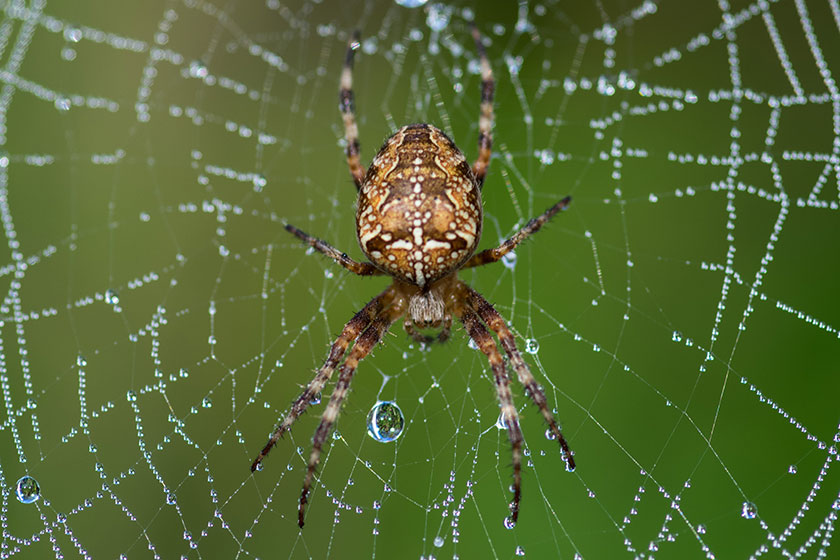
The above picture was copied from the Natural History Museum, London and shows the full beauty of the web spun by what we in Britain know simply as the garden spider.