Tag: belief

  • Wise men follow the Stars

    The Star of Bethlehem, a UFO, fabrication, or astronomical computation?

    https://www.skyatnightmagazine.com/news/star-of-bethlehem-stopping-comet

    The fixed date of December 25th when the Christians mark the birth on Earth of the son of God stands as a bit of an anomaly in these deep winter weeks in the northern hemisphere, although taken to its logical conclusion, the outcome is very clear.

    Helios at Winter Solstice has an overarching logic. Incrementally the Light from the Sun moves down the horizon, rising and setting lower and lower in east and west until that deep place of pause around the 21st, given as 3:03pm GMT this year in clock accuracy, and laid out by the priests of olde as in the evidence at Newgrange where the newborn Light of the World enters the small portal above the entrance at the turn again from Tropic of Capricorn on its way up to the Tropic of Cancer. We know now that the tilt of Earth on its axis produces this effect but Light is light, and life within the atmosphere depends on it, and which is why in times past the reality of food supplies, frozen winters, circadian rhythms, and the survival of a small society depended on knowing ‘the time of the year.’

    In pre written calendar times the knowledge of passing of time during the dark months would be very useful, and it was known, as Newgrange demonstrates, and the work of Prof. Alex Thom has measured. Prof. Thom, 1894-1985 grew up in 55′-56’N and although his extensive work was roundly put aside by the growing scientific disciplines and specialisms and sub divisions, his work has been proved, and back in those days, life on Earth was in 3d. Not on a digital screen, but from one place and one place only on Earth, in a landscape, with the vast arc of the starry sky overhead. With his son, Dr. Archie Thom, and Dr Euan MacKie, another independent worker therefore able to observe natural facts, their body of written work of astroarchaeology stands as a comprehensive and systematic portrayal of the comprehensive and systematic activity of Neolithic societies in ancient Briton and western Atlantic seaboard. What is astroarchaeology? In a nutshell it could be said to be the societal functioning in alignment with Earth, Helios, Selene, and the brightest stars in the sky at that time.

    https://rss.onlinelibrary.wiley.com/doi/full/10.1111/j.1740-9713.2009.00368.x https://theorkneynews.scot/2024/12/29/book-review-walking-in-all-of-the-squares-alexander-thom-engineer-and-archaeoastronomer/

    https://www.archaeopress.com/Archaeopress/Products/9781784918330

    Prof. Thom, Dr Euan MacKie, 1936-2020 and down to the present day of Duncan Lunan continuing the work https://www.duncanlunan.com/thestonesandthestars.asp

    With the geographer’s eye and knowledge again, Robin Heath – Bluestone Magic, Temple in the Hills (Bluestone Press) in 2016, right into the big scientific data era, shows how humans marked out their calendar, as did all human societies over Earth as the available Light of the Sun moved from the tilt of the Earth, and some still do. Robin Heath –https://www.skyscript.co.uk/moonheath.html – speaks of what all native societies practice, because there is nothing else. T

    he Hebrew calendar in the ancient Middle East marked festival days from lunar and solar correlations, making it not an exact ‘modern calendar’ day, just as the first Full Moon of the new Lunar cycle in Anglo-Saxon pagan was known as the Wolf Moon, from the sound of wolves calling in the cold, then icy, nights. And beyond the Anglo-Saxons, Germanic Yule and Scandinavian Jol, fortunately for them less interrupted societal practices and still active participation with Odin and Freya and the pantheon of gods and godesses and alignment with the true facts of Sol and Earth, enter the Jul Blot in accordance with the dying and rebirth of the Light. Drinking and feasting and sacrificing, it is in the rising again of the Light of the World.

    Yule now put, especially among us pagan folk, as the 21st December being keen to reinstate something of societal stability based on reality in the ‘UK’ is not Celtic but fully Germanic and Norse, and is not the date of 21st December. That is the Winter Solstice itself. With the traumatic history of Britain from Christian belief, it is relative and not intended as actually wrong, merely the best that we can do under difficult circumstances of the last 1,500 years. Constantine’s 336 CE declaring Christianity the official state religion required a festival day, in true pagan practice, and the allocation of 25th of December as the birth of Jesus Christ can be read as a, or the, major departure from the real facts of humans upon the Earth. The evidence shows Constantine acted from political expediency for all the reasons that study of that period open up, but from western society on a mass of spinning rock in space, the fixing of a son of a god in the sky born in a manger on December 25th puts the Son of the Christian god and the Sun, Helios, Sol, An Ghrian, which is the fundamental fact of existence on Earth in direct conflict. At first, and for several 100s of years, the Christian festival on December 25th merged in with the traditional Roman feast of Sol Invictus, given by Aurelian in 274 CE as the official Roman cult, the Unconquered Sun, because no human can conquer the Sun, and the fun of Saturnalia, merged in with the Jewish month of Kislev. The eastern Mediterranean peoples were Greeks, Jews, Romans, with the centres of Alexandria, Antioch, Constantinople and Ephesus. We here in Britain were definitely still barbarians in that time. Study of the switch from the Sun to the Son tends to stay within history and not theology, for the reason of this fundamental and unreconcilable belief in facts. Belief in the Son leads away from Earth into a place so unconnected with Earth that it is hard to see in 2025 nearly 2026 how folks can still hold such beliefs, but they do. Belief in the Sun, in the inevitable moving down the horizon into winter months, the portal of Winter Circle of stars, magnitude one stars, bright and clear, of Capella, Aldebaran, Rigel, Sirius, Procyon, and Pollux, with Orion clear in the middle, and the vast history of human societies into the portal, down, and out into the reborn Light, as one human gets incrementally older and passes on into spirit, and new humans are born, but always contained within the majestic facts of Earth and Sol, Earth and Sky.
  • The Vexed question of Vexillology – Part 4

    St. Andrew’s Day in Scotland and Russia, 30th November 2025

    Lactantius (Lucius Caeclius Firmianus Lactantius), a Christian advisor at the court of Constantine I, wrote in ‘On the death of the Persecutors’ that Constantine had had a dream before the battle of Milvian Bridge to place the Chi Rho symbol of Christ’s name on his soldiers shields. Constantine did win at Milvian Bridge, against Maxentius, whose head was paraded through the streets of Rome and became sole ruler of the western Roman Empire, and after defeating the eastern Emperor Lucinius in 324, ruler of the entire Roman Empire, ending the complications under shared rule of the Tetrarchy and the geographical impossibility of cohesion between such a huge territory. The one Christian God instead of pagan practices and the pantheon of gods headed by Jupiter, Juno and Minerva was a novelty and one God, one Emperor sat well for Bishop Eusebius’ ambitions for the rise of Christianity.

    The Chi Rho as Labarum military flag under Constantine could be said to mark a divergence in Vexillology between function of humans on land, and manipulation of belief, Constantine as a Christian or Constantine as a follower of the Sun, the source of Light and Life for all of earth, and as Sol Invictus which from Aurelian in 274 had been the official Roman cult. The Persian cult of Mithras, coming into the Roman Empire from eastern territories, was the elite Army cult, with initiation ceremonies and secret practices, such as all elite groups have and need to have to perform their difficult function for their society. Mithras, a Sun-god, was the god of contract, truth and justice, because Helios is the ultimate measure of all life on Earth, at whichever latitude and by whichever name. What exactly Constantine I was referring to as the God in the sky, it was directed by those with the writings and those with the intent to interpret for the Christians.

    Bishop Eusebius of Caesarea in his ‘the Life of Constantine’ started in 337 when Constantine I died, and uncompleted at Eusebius’ own death in 339, wrote that Constantine had definitely told him that before the battle of the Milvian Bridge in Rome, 25 years before, he and his soldiers saw a vision of a cross in the sky, and the Christian god saying, ‘In this sign, conquer’.

    https://www.numisforums.com/topic/6146-what-if-constantine-had-seen-this-instead

    https://www.thecollector.com/constantine-the-great-christian-religion-or-pragmatist

    A mere 500 years later, in present day East Lothian, the battle now known as the battle of Athelstaneford, at the Peffer Burn, was recorded by Water Bower, b. 1380s in Haddington, (by that time in Scotland not Northumbria) in his ‘Scotichronicon’, written in his latter years in the 1440s as Abbott of Incholm Abbey, on a small island on the north coast of the Firth of Forth. Walter Bower studied at St. Andrew’s University, in the town which c.1200 had acquired some relics of St. Andrew and the town was named St. Andrews. The now major pilgrimage centre brought much money and trading activity to the town. St. Andrew was said to have been martyred on a diagonal cross at Patras in the 60’s CE, and his symbol of a white diagonal cross on blue background decreed as identification on soldiers uniform by the Scottish Parliament in 1385.

    A jurisdiction and a government needs to be identified, and the human as a biological animal uses eyes to identify images and physical objects. It has also the senses of touch, sound, taste, and various others, but sight is the definition of human societal groupings, ethnicity and territory.

    In Bower’s writing, the battle at Athelstaneford in 832 had Athelstan, King of the Angles, meeting (in the battle sense) the Picts under Angus mac Fergus in their incursion into the territory of Northumbria, aided by the Scots under Eochaidh, King of Dalriada. As the oral tradition went, the northern folks saw a white cross of St. Andrew in the sky before the battle, and the Saint aided them in a great victory against Athelstan and his southern army, after which like the Chi Rho, the cross of St. Andrew became the symbol of the new united Picts and Scots in Alba under Kenneth MacAlpin in 843, the grandson of Eochaidh, and so Alba became modern Scot-land, not Pict-land. Pict-land of the geography above the Firth of Forth, and the Scots to the west, above the Clyde, lived within the natural geographical demarcation of Stirling, the portal from north to south, and in times long gone by when the water level was higher, the only land travel place. Such are the conditions for the human created by geography.

    Walter Bower, in formalising real historical movements and battles between very different tribes and societal groupings in their very different geographies of north and south Britain, and west and east, wrote of the event around the Peffer Burn. Athelstan however was not born until the 890s and was the King of the Anglo-Saxons 924-927, and uniting by emerging as the victorious, King of a united England 927-939. There was a united Alba-land and a united England. The King Athelstan of the 900s did campaign (in the old sense of the word which meant a military excursion to create maximum destruction against the enemy) in the north, against Constantine and a combined forces from Dublin and Vikings, an almighty collision of different newly solidified powers within Britain. The site of this victory for Athelstan is put variously over middle Britain from the Wirral to Yorkshire to the present day Scottish lowlands, and far from the events in 832 in Peffer Burn.

    It is those events, even if now historically mixed up in Athelstan who has his name as the village of Athelstaneford even if he could not have been there. Eanred was King of Northumbria 810-841, so maybe it was he who met the Picts and the Scots at the Peffer. Who knows. But the Saltire of white diagonal cross on blue background nearly 1,200 years later is unchanged, and the feast day of St. Andrew on November 30th is marked throughout Scotland as flag and Saint combined. Russia also marks the feast day of St. Andrew on November 30th, under the Russian flag of white, blue and red horizontal stripes.

    Athelstaneford is in East Lothian, in Scotland, with the Scots and the English fighting all the way through the centuries and Berwick upon Tweed and Carlisle castles being captured, by both sides many times, bloody battles, prisoners and razing to the ground. East Lothian in then Northumbria, and the events around the Peffer Burn birthing the Saltire image of peoples beyond Stirling, to the Scotland-England border fights along the river Tweed, to English taking Berwick again and a now border of part geography of the Tweed, part England up to Eyemouth, the debateable lands subdued over west and the Solway forming the other end of the turbulent history, these latitudes of 55′-56’N, we contain here a microcosm of a complicated macrocosm and possibly with the cross of St. Andrew a flag of Christian belief and the cross of St. George a flag of Christian belief with St. Patrick added into the Union Jack in the 1801 ‘Union’, could there be a more comprehensive study of flags, land, belief, ethnicity, shifting territory, and the relationship of image to identity?

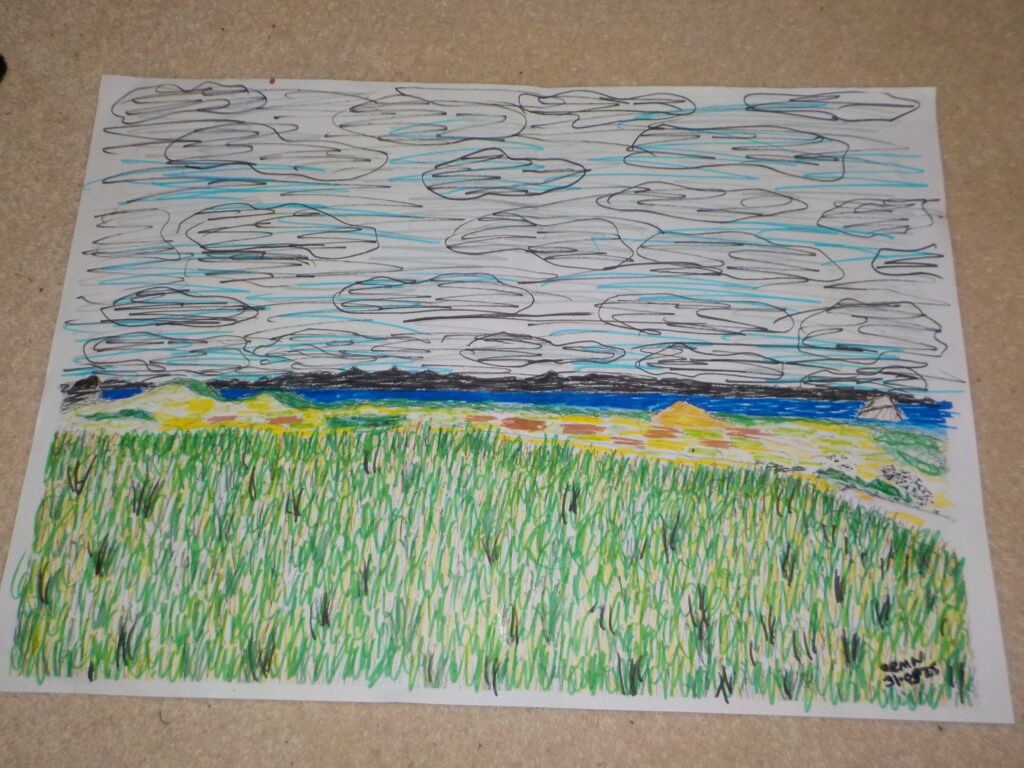
    A sketch from Trapain law overlooking East Lothian and Firth of Forth, AEMW 31.05.2025